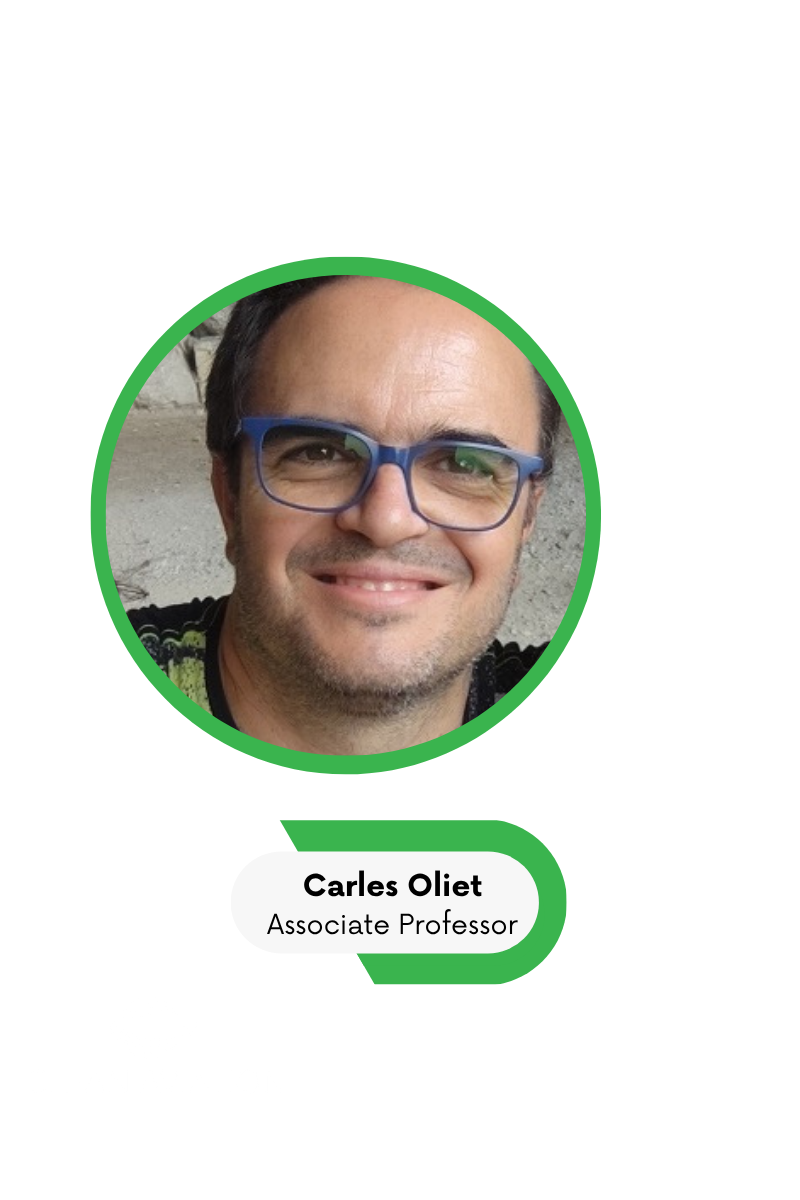
Personal Information
- Name: Carles Oliet
- Position/Title: Associate Professor
- Department: Centre Tecnològic de Transferència de Calor (CTTC) of Universitat Politècnica de Catalunya (UPC)
Professional Background
Briefly describe your professional background and area of expertise:
I am a Mechanical Engineer, specialised in Thermal Engineering (PhD in this area). I have been conducting research on applied heat transfer across different fields, in particular, heat exchangers and air-conditioning and refrigeration equipment. In recent years, I have been working on several applied projects related to more-electric aircraft, ranging from power electronics cooling to numerical analysis of aircraft air-conditioning systems.
What inspired you to pursue a career in this related field, e.g., aviation, carbon-free emissions etc?
My natural curiosity and the pursuit of knowledge and excellence pushed me into an academic career.
The use of renewable energy and a more rational use of energy were my original, inspiring objectives, which later became interlinked with the climate change challenge and the decarbonisation of society.
Role in H2ELIOS
What is your role in the H2ELIOS project?
I am technically leading the CTTC-UPC team, which is responsible for supporting the Consortium with the thermofluidic design aspects of the LH2 cryogenic tank and the parallel development of a thermal Digital Twin. I have been directly contributing to the design support and the development of the numerical system-oriented tools.
Can you describe your main responsibilities and tasks?
As commented, thermo-fluidic aspects have been progressively covering topics such as H2 and insulator thermophysical properties at cryogenic conditions, characterisation of the tank multi-layer structure insulation and thermal bridges, and numerical evaluation of the tank response in different scenarios (dormancy and boil-off, cool-down, consumption). In the last part of the project, the analysis has been extended to the systems (piping, valves, etc.) that connect it to the rest of the system, to numerically simulate their coupling.
How does your work contribute to the overall goals of the H2ELIOS project?
The project encompasses a unique team with a wide portfolio of skills and expertise, necessary to tackle the technical challenge of developing, constructing, and testing an LH2 cryogenic tank. The CTTC-UPC team has been supporting the thermo-fluidic aspects of the tank during the design phase, which has allowed us to consolidate or highlight difficulties in the design proposals from the other partners. In the last part of the project, this support has been extended to the thermofluidic aspects of the experimental set-up. In parallel, the simulation tools used in the project have crystallised in the development of a thermal Digital Twin, which becomes a crucial tool to extrapolate in the future the experimental test results to other conditions or tank sizes (scalability).
Project Insights
What do you find most exciting about working on the H2ELIOS project?
The feeling of really contributing to a cutting-edge research project, with a consortium and coordinator really involved in the endeavour.
From my personal and team perspective, to observe how our transversal thermo-fluidic experience and knowledge were really useful to progress on the tank design and the decision-making.
What has been the most challenging aspect of your work on this project?
The novelty of the topic and the singularity of the design have pushed the team into a continuous challenge track throughout the project, with a wide range of thermal aspects and scenarios to be studied. In particular, the characterisation of the open cell thermal conductivity in the specific H2ELIOS design conditions was an unexpected and challenging aspect that was finally solved successfully and became a critical tool for the project's progress.
Can you share a significant milestone or achievement your team has reached so far?
As commented above, the generation of an open cell thermal conductivity and specific heat models under the specific working conditions of the H2ELIOS tank has been a crucial technological brick. On the other hand, the successful development of a thermal Digital Twin system designed to provide fast operational predictions has also been an important achievement of our team.
Personal Experience
What have you learned during your time working on H2ELIOS?
The most unique learning of H2ELIOS has been the multidisciplinary work towards a single objective, which has allowed us to work closely with other partners dedicated to build the tank, the tank interfaces, the experimental set-up, the structural modelling, etc.
How has this project influenced your professional development?:
Absolutely, it has allowed us to consolidate our cryogenic thermal analysis work and mature our numerical tools, and, personally, has given me better expertise in the LH2 storage niche. From these assets, we are currently extending the application to other cryogenic tanks (other uses/sectors).
Fun Facts
What do you enjoy doing in your free time?
Go mountain biking, play table tennis, and observe nature.
Share a fun fact about yourself that your colleagues might not know:
My first contact with a trial motorbike of a friend, almost flying instead of riding…
Closing Thoughts
Is there anything else you would like to share about your experience with the H2ELIOS project?
The importance of working in a team environment in our research group. Even being the technical leader and playing a relevant role in the design and simulation work, the CTTC-UPC complex task would not have been possible alone. The continuous support and collaboration of my colleagues Eugenio Schillaci, Marcial-Francisco Mosqueda-Otero, Jesús Castro and Joaquim Rigola have been crucial all along the project and deserve an acknowledgement.